LifeTrack Pro
Unified day-to-day life management platform for students to structure daily routines, maintain focus streaks, and collaborate in peer study groups.
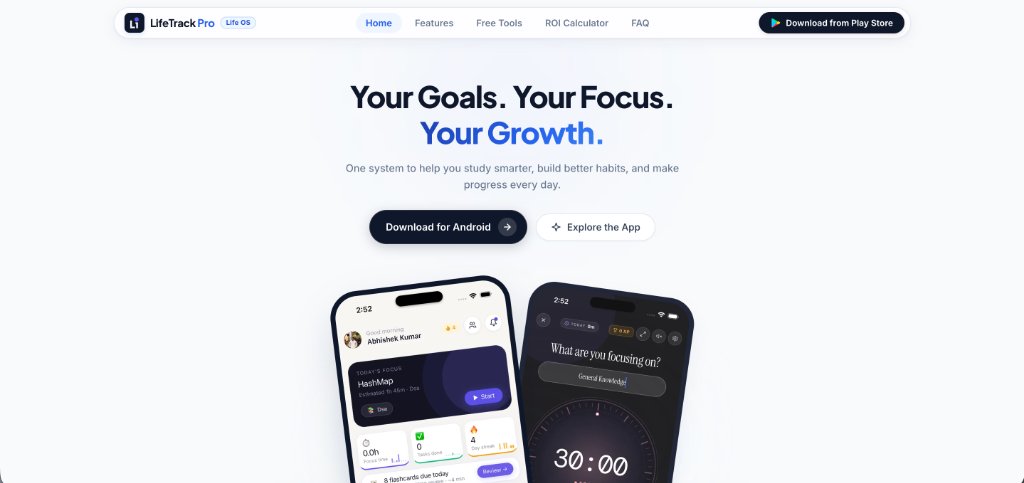
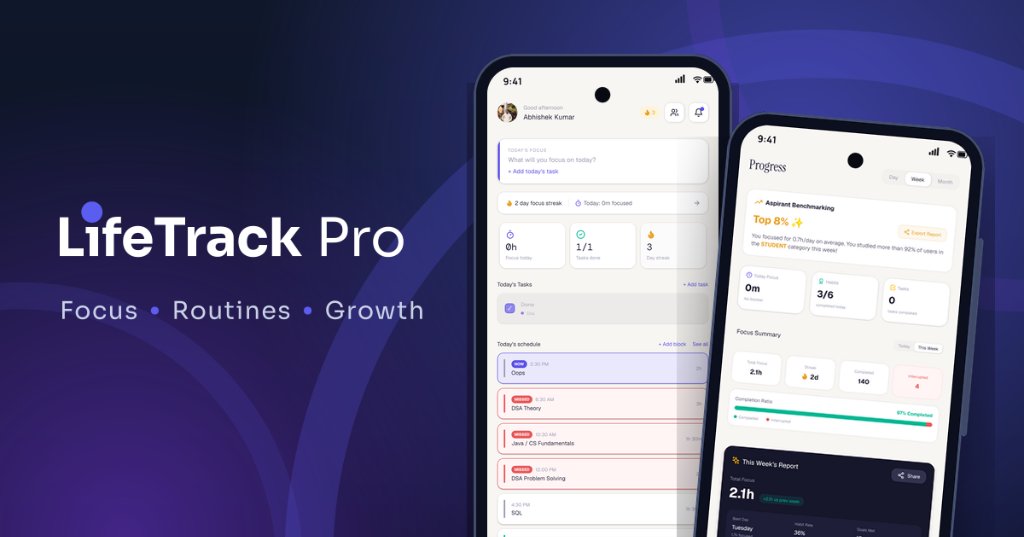
Web Platform & Mobile Interface
Tool Fragmentation
Students constantly switch between separate calendar apps, standalone pomodoro timers, habit apps, and messy WhatsApp groups.
A single unified timeline unifying daily routines, focus sessions, and groups.
Rigid Routine Decay
Corporate calendar tools enforce rigid timestamps. When a class runs over, the day's schedule collapses and causes demotivation.
Fluid task-oriented flow blocks that shift adaptively without breaking streaks.
Isolated Self-Study
Studying alone without peer presence makes it easy to procrastinate and abandon long-term exam preparation goals.
Live peer presence rooms with mutual focus countdowns and consistency benchmarking.
| Considered Feature | Why We Rejected It (Ifs & Buts) | What We Shipped Instead |
|---|---|---|
Public Social Feed & Status Posts | High risk of turning a focused tool into another doom-scrolling distraction. Demands heavy moderation and adds zero value to daily study discipline. | Silent live presence indicators—students see peer focus state without vanity likes or feeds. |
Full In-App Chat & DMs | WhatsApp and Telegram already dominate group chats. Building chat adds notification fatigue and shifts users from studying to chatting. | Synchronized study rooms with live focus timers and mutual streak visibility. |
Gamified XP Points & Competitive Leaderboards | Encourages users to game the system (leaving timers running idle) and causes toxic comparison rather than intrinsic consistency. | Private consistency streaks and weekly self-benchmarking against historical baseline. |
Complex Multi-Nested Subtasks & Gantt Charts | Over-engineered planning creates friction. Students spend 30 minutes organizing and 0 minutes studying. | Lightweight drag-and-drop daily routine blocks with 1-tap completion. |
Mandatory Webcam / Video Study Rooms | Severe battery drain, high bandwidth demands, and student privacy hesitation in hostels/dorm rooms. | Low-latency socket presence with ambient focus avatars and timer sync via Supabase. |
High risk of turning a focused tool into another doom-scrolling distraction. Demands heavy moderation and adds zero value to daily study discipline.
Silent live presence indicators—students see peer focus state without vanity likes or feeds.
WhatsApp and Telegram already dominate group chats. Building chat adds notification fatigue and shifts users from studying to chatting.
Synchronized study rooms with live focus timers and mutual streak visibility.
Encourages users to game the system (leaving timers running idle) and causes toxic comparison rather than intrinsic consistency.
Private consistency streaks and weekly self-benchmarking against historical baseline.
Over-engineered planning creates friction. Students spend 30 minutes organizing and 0 minutes studying.
Lightweight drag-and-drop daily routine blocks with 1-tap completion.
Severe battery drain, high bandwidth demands, and student privacy hesitation in hostels/dorm rooms.
Low-latency socket presence with ambient focus avatars and timer sync via Supabase.
Architectural Trade-offs
Task-oriented flow blocks over rigid calendar timestamps
Why: Students need flexible routine blocks (e.g. DSA Revision, Core CS) rather than rigid corporate calendar slots that cause friction when schedules shift.
Trade-off: Required custom drag-and-drop schedule block rendering in React Native.
Synchronized peer study presence over asynchronous messaging boards
Why: Seeing active peers studying live creates immediate accountability and motivation compared to stale forum posts.
Trade-off: Demanded robust real-time presence subscriptions on Supabase with automatic reconnection.